
- AI Skills
- Interview
- Careers
Anyone Can Learn AI in a Weekend. Here’s What to Learn First.
“Startup King” Greg Henson on the AI skills that matter now, and how to start from zero
7 min readWritten by Amy Gallagher

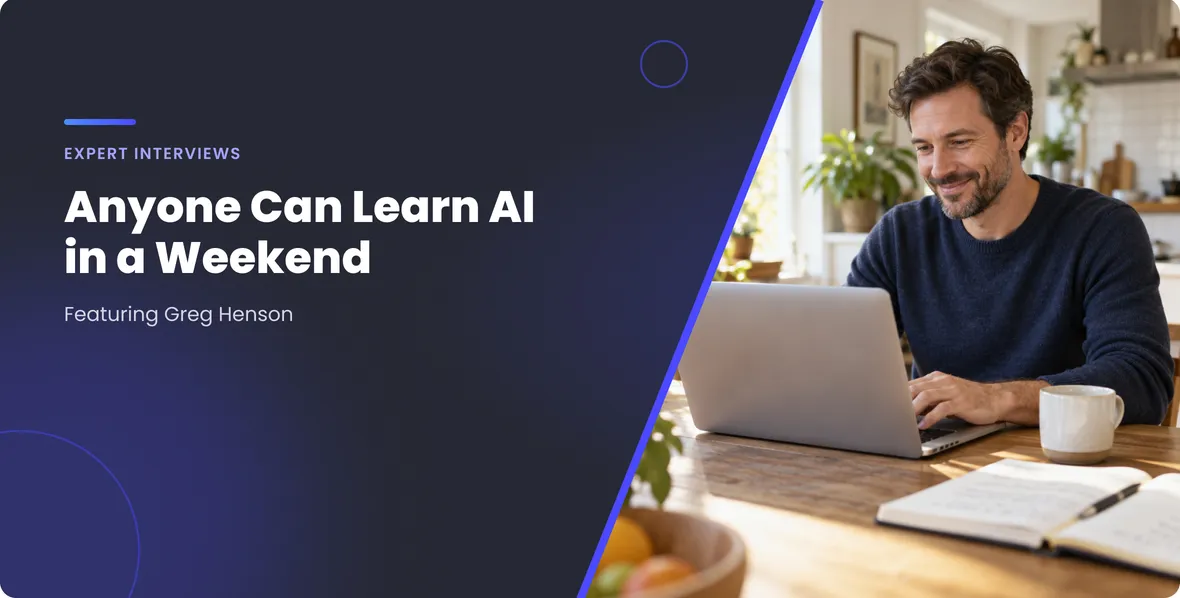
Here’s the thing about resumes in 2026: they all look amazing. AI can polish anyone’s experience with the perfect keywords in seconds. So if every candidate looks brilliant on paper, what actually makes someone stand out? And if you’re building your own business, which AI skills are worth your time?
We sat down with Greg Henson, CEO of SocialPost.ai (opens in a new tab), founder of Henson Venture Partners (opens in a new tab), and founder of the veterans’ charity Cloud Veterans (opens in a new tab), to find out. Greg built one of the largest Microsoft Azure partners in the world, has backed more than 50 startups, and now runs an AI company where six people manage around 500 AI agents.
He’s hired for 20+ years, and he says the last two have changed everything. Spoiler: he barely reads your resume anymore. He wants to see what you can actually do with AI.
The good news? Greg is adamant that anyone can learn this, even starting from zero, and he’s helped thousands of people do exactly that. He’ll show you where to start.
The resume tells him nothing. The laptop tells him everything.
Greg puts far less weight on resumes than he used to. “Everyone has a great resume because, you know, AI wrote it,” he says. “I screen for results. I don’t screen the resume.”
So when a candidate looks good on paper, he asks them to open their laptop, share their screen, and show him what they’ve actually built or automated with AI. “Until you get into the nitty-gritty, you really don’t know their capability.”

“Everyone has a great resume because, you know, AI wrote it.”
That doesn’t mean you can leave AI off your resume. Greg calls it table stakes, just like Excel and Word were a decade ago. “If you don’t have it on there, it’s kind of a red flag, honestly.” Put it on there, then be ready to show it.
If you’re new to AI, that’s actually good news. Proof doesn’t have to be fancy. It can start with one everyday task you’ve handed over to AI and can walk someone through.
Where are you on the AI ladder?
Greg thinks of AI skills as a ladder, and every rung is learnable:
- Chat. Asking AI questions, like a smarter Google. This is where most people are, and it’s exactly the right place to start.
- Agents. An AI agent doesn’t just answer a question. It completes a task for you, like sorting your inbox or drafting a report from your files. Tools like Claude Cowork let you do this without writing any code.
- Teams of agents. Several agents working together on bigger jobs. This is where Greg starts to get impressed, but it’s a destination, not a starting line.
Here’s why that’s encouraging. Greg points to a stat he came across recently: around 99% of people only use AI as a chatbot. So if you climb even one rung, you’re already ahead of the crowd.
And you don’t need to find time for a course to take that first step. At the end of the day, just ask the AI how you could have used it better. “It will tell you, ‘Hey, you shouldn’t be asking me to do this. You could automate that,’” Greg says. “It will teach you, if you allow it to teach you how to use it.”
The new hire who onboarded himself
Greg’s favorite example of an AI-native hire is a developer who joined SocialPost.ai. Every new employee gets a Claude team plan on day one, already connected to Microsoft 365, Jira, GitHub, and the rest of the company’s systems. On day two, Greg personally blocks out half a day to run their orientation.
This time, he barely got started. “He goes, ‘Let me stop you right there. I’ve already been onboarded.’” The new hire had given AI his job description and connectors, and it went through the company’s systems, built an onboarding plan, and onboarded him in about two hours.
“My jaw hit the floor,” Greg says. He quizzed him on everything, and the new hire knew it all, plus a list of things he thought the company should change. He didn’t just fill a role. He changed how the company onboards everyone.

You’re only a weekend away from catching up
Through Cloud Veterans (opens in a new tab), Greg has helped thousands of veterans move into cloud and AI careers, many starting from zero. His message for anyone feeling behind: “You’re only a weekend away from catching up to speed with everybody else on one particular tool.”
“You’re not as far behind as you think you are. You’re only a weekend away from catching up to speed with everybody else.”
His three-step weekend plan:
- Pick one tool and learn the chat side. There’s a ton of free training out there. Tinker, ask it questions, and test what it can do.
- Learn which model to use. Most AI tools let you choose between quick, lightweight models and slower, more powerful “thinking” ones. Most people skip this step, but picking the right one saves time and money. “It’s like taking the Lamborghini to go get milk at the grocery store. You don’t need a Lamborghini to do that.”
- Try your first agent. Once you’re comfortable, hand AI a small task to complete for you from start to finish.
And don’t be intimidated: these tools change so fast that even Greg is constantly relearning them. “Everyone feels like they’re drowning. Nobody feels like they’re up to speed on AI.” In other words, the playing field is more even than you think.
Want a shortcut? A course provider like ClickTech HUB (opens in a new tab) gives you proper guidance, so you skip the trial-and-error and get to the useful stuff faster.
Six people, 500 agents, the work of a hundred
The old way to grow a company was simple: win more customers, hire more people, repeat. “Today, that’s the most expensive option on the table,” Greg says. At SocialPost.ai, six employees run around 500 agents between them, and he estimates they’re doing the work of about a hundred people.
If you’re thinking about starting a business, this is the headline: you no longer need a big team, or a big budget, to do big things. A small team that knows how to use AI can now compete with companies many times its size.
But don’t mistake that for AI replacing people. Managing agents is real work. With human staff, feedback might come weekly or at an annual review. With agents, it’s every single day. “It doesn’t matter how smart they get. They’re still dumb,” he laughs. You don’t check every email a competent colleague sends, but you do have to keep spot-checking your agents, because “agents gone wild” can damage a business fast.
That’s exactly why Greg isn’t worried about AI wiping out jobs. “They still need people to manage and monitor and track and audit what these things are doing. That is going to take a human in the loop, and that will never change.”

Laid off, then hired back at double the salary
If you want proof that AI skills create job security, Greg has it. He knows people who were laid off before the AI boom, went deep on agents and orchestration, and then went back to their old boss with a pitch: let me automate 80% of my former role, build and manage the agents, and come back at double the salary.
They got hired back. Why? Because they combined what they already knew about that company with what they’d learned about AI. “If you’re able to be two, three, 5x more productive, you have a lot more job security,” Greg says.
“If you’re able to be two, three, 5x more productive, you have a lot more job security.”
What “AI skills” means depends on your role
AI skills look different depending on the job, and Greg hires for that. For content and marketing roles, he looks at taste: soft skills, design sense, and the look and feel of the work. For developers, it’s more technical. But you don’t need to be technical to use AI well, and finance is the proof.
One of Greg’s international companies used to convert every country’s monthly balance sheets and income statements into US dollars by hand. Then the finance lead figured out how to use AI inside Excel, and the whole process got automated. The takeaway: what matters is knowing how AI fits your own work.
Greg thinks companies should go further and rewrite every job description written before AI. “Probably half of the responsibilities in the pre-AI job description can be wiped off and replaced with more important, value-added things,” he says. His shortcut: hand your job descriptions to AI, let it do the first pass, keep what you like, and throw the rest away.
Start with your own life
Greg’s number one tip: book the time to learn AI into your diary. Greg blocks out at least eight hours of “tinker time” a week. “That’s how you’re going to learn, and that’s how you’re going to master it.”
If you don’t know what to use it for, start at home. Ask it to find savings in your utility bills, or flag suspicious fees on your credit card statements. Greg uses it to plan his kids’ weekly schedules. He even photographed the serial numbers on every appliance in his apartment, had AI track down all the user manuals, and built an agent that answers questions like why a remote is flashing red. It’s now, in his words, “my chief of staff of all my appliances.”
“Start on your personal life, and once you understand how it works, you’ll start to see how you could apply it to your work.”
You’ll never feel fully caught up. That’s normal.
Greg’s final word of advice is reassuring: nobody has AI fully figured out, including him. “You’re never going to feel like you are fully there. That’s normal these days. Don’t be intimidated.”
Start small, in one corner of your life, and let it grow from there. “It’ll expand your mind, and you’ll start to apply it more and more the more you use it.”
“You’re never going to feel like you are fully there. That’s normal these days. Don’t be intimidated.”
So here’s the real choice: keep polishing a resume that looks like everyone else’s, or build the kind of AI skills you can open your laptop and prove. One weekend is all it takes to start.
ABOUT THE EXPERT
Greg Henson
Gregory Scott Henson is a serial entrepreneur, super angel investor, and educator known as “The Startup King.” He is CEO of SocialPost.ai (opens in a new tab), a venture-backed and profitable AI platform with 15,000+ users, Chairman of the Board of ALIANDO, and Founder and Managing Partner of Henson Venture Partners. He founded Henson Group in 2002 from a one-bedroom New York apartment and grew it to $70M in annual revenue as the world’s #1 Azure CSP, ranking #132 on the Inc. 5000, before merging it into ALIANDO. He is also Founder and Executive Director of Cloud Veterans, a non-profit that has helped thousands of veterans move into cloud and AI careers. A 50X angel investor, 20X founder, and 4X CEO, he has been featured in AP, Yahoo Finance, and Morningstar.
Website (opens in a new tab)SocialPost.ai (opens in a new tab)Cloud Veterans (opens in a new tab)Greg’s LinkedIn (opens in a new tab)

